Xanthelasma Removal at Home? Not a Good Idea
If you've heard that you can perform xanthelasma removal at home with a needle, it's not true. Creams also won't get rid of the yellow growths that develop on or near the corners of the… Read On

Toronto, ON: (416) 663-9649
The Centre for Minor Surgery
4025 Yonge St, Suite 205
Toronto, ON M2P 2E3
Phone: (416) 663-9649
Monday–Friday: 8 a.m.–4 p.m.
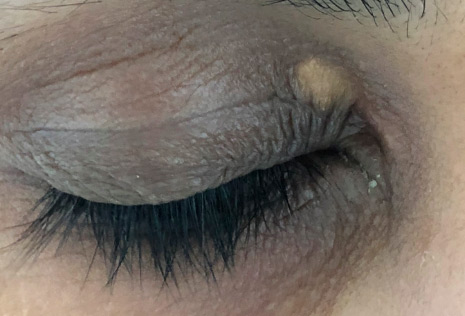
While not harmful, eyelid xanthelasmas can be unsightly, draw attention, and create self-consciousness. Our plastic surgeons at The Centre for Minor Surgery (CFMS) offer xanthelasma removal in Toronto to help patients from Barrie, Mississauga, and surrounding cities get rid of these yellow patches that form around the eyes and detract from their appearance and confidence. Our scar-minimizing techniques leave behind little evidence of the procedure.
Xanthelasmas are collections of cholesterol that form in the skin and create unsightly yellow plaques. They most often occur in the upper and lower eyelids. While they can be associated with having high cholesterol, this is not always the case.
Eyelid xanthelasmas are harmless, not painful, and do not need to be removed; therefore, xanthelasma removal is not covered by OHIP. Because xanthelasmas can be associated with high cholesterol, it is important to have your cholesterol checked by your primary care physician. It’s important to know that lowering high cholesterol levels will not cause xanthelasmas to go away.
At our clinic in Ontario, Canada, xanthelasma removal is priced per eyelid and varies with the size and location of the lesion. We will provide you with a specific price prior to your procedure. However, you can view general pricing information on our pricing page.
Xanthelasma removal at The Centre for Minor Surgery is a precise, in-office procedure that safely treats the delicate area around the eyes while supporting optimal cosmetic results.
During your procedure, you can expect:
Together, these steps reflect our commitment to precision and patient comfort throughout every xanthelasma removal procedure.
Healing after xanthelasma removal is typically straightforward, with most patients returning to normal activities within a few days. You may experience mild swelling, redness, or bruising around the eyelids for the first several days, which gradually improves. If sutures are used, they are often dissolvable and do not require removal. Keeping the area clean, applying ointment as directed, and avoiding rubbing or strain on the eyelids will support proper healing. Most incisions fade well over time.
As with all surgeries, a scar is left behind after xanthelasma removal. It generally heals very well and fades into a very fine line in the eyelid folds. The aesthetic benefit of the procedure generally far outweighs the resulting scar. Occasionally, xanthelasmas may redevelop over time.
No, xanthelasma does not typically go away without treatment. Once formed, the deposits tend to remain or slowly enlarge over time unless they are removed.
Yes. While xanthelasma is often associated with elevated cholesterol or lipid levels, many people who develop it have normal bloodwork. Genetics and other factors can also play a role.
Early xanthelasma usually appears as small, soft, flat yellowish patches on the inner corners of the upper or lower eyelids. These areas are typically painless and may gradually become more noticeable or spread over time.
Xanthelasma is a type of xanthoma that specifically appears on the eyelids. Xanthomas are broader cholesterol-rich deposits that can develop in other areas of the body, such as the elbows, knees, hands, or tendons.
Visit our FAQs page for more information about minor surgery at our centre.
To meet with one of the plastic surgeons at The Centre for Minor Surgery in Toronto, book a consultation using our online form or by calling
(416) 663-9649.
No referral is needed.
Easy online appointment request – no referral needed
Same day procedures save you time
Get back to your life without missing a beat
At The Centre For Minor Surgery our goal is to provide excellence in surgical treatment for benign and cancerous growths. We strive to overcome the problem of long waiting times. No referral is needed to be seen by one of our Royal College-certified plastic surgeons.
